Children's Dentistry
Your Child's First Dental Visit: What to Expect and How to Make It Stick
Written by: The Caddens Dental Bar Team · Updated August 2026 · 8 min read
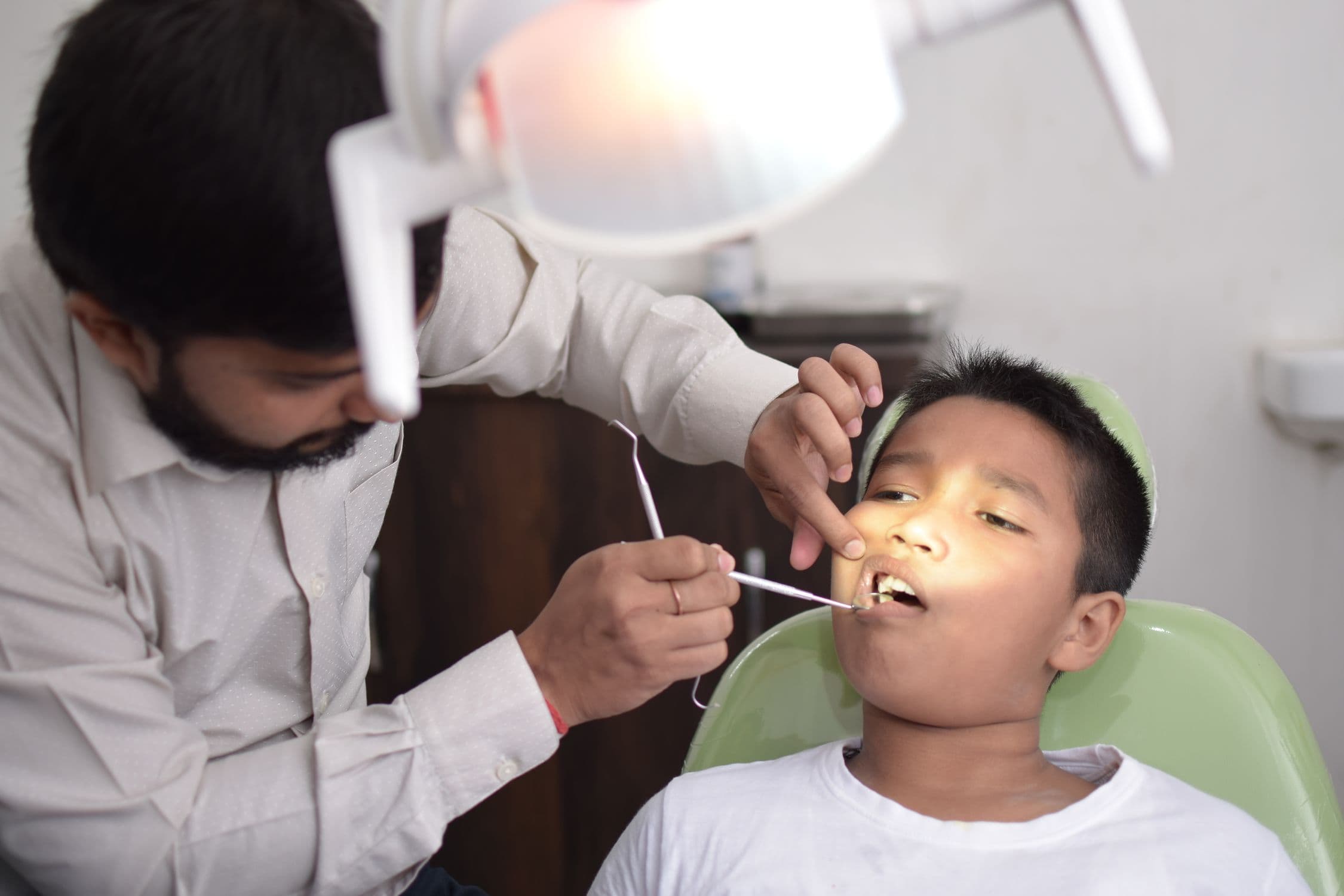
Mention a dentist appointment to a small child, and the reaction isn't usually excitement.
That's not the child's fault — it's what they've absorbed from adults who've had reason to dread it.
The first visit, though, is genuinely uneventful: a quick look inside, a tooth count, a few questions for the parent, and done.
Getting there early — before there's a problem — is the one thing that makes every appointment easier from that point on.
Key Takeaways
- +The Australian Dental Association recommends a child's first dental visit by their first birthday — or when the first tooth appears, whichever comes sooner
- +The first appointment is almost entirely an assessment — the dentist looks at tooth development and gum health, with very little done beyond the exam itself
- +Eligible children can access up to $1,158 in Child Dental Benefits Schedule funding over two consecutive calendar years (for benefit periods starting in 2026)
- +Most children are reviewed every 6 to 12 months after the first visit — the right interval depends on their individual decay risk
Earlier Than You're Probably Planning
The Australian Dental Association recommends that a child see a dentist by their first birthday, or as soon as their first tooth appears — whichever comes first.
That sounds early, and most families do go later. An ADA survey of 25,000 Australian adults found that only about a quarter correctly identified age one or younger as the right time; most put the number at two, three, four or older.
Going sooner doesn't mean subjecting a baby to treatment. It means the dentist can check that teeth are coming through in the right order, spot early staining or decay before it deepens, and start building the kind of routine that makes your child feel comfortable in the chair — at an age when nothing is yet scary.
What the First Visit Actually Looks Like
A lot of the anxiety around first dental visits comes from imagining something far more involved than what actually happens.
A Look, Not a Treatment
Young children — infants included — often sit on a parent's lap while the dentist has a look. The dentist is checking how many teeth have come through, whether they look healthy, and how the jaw is tracking developmentally. Almost nothing gets done beyond that examination. If your baby is six months old and has one tooth, that tooth gets looked at — and then you go home.
The Conversation With You Matters Too
A big part of the appointment is directed at the parent — brushing technique, toothpaste strength by age, whether thumb-sucking is worth watching, what to do if a tooth looks discoloured or falls out unexpectedly. Come with your questions.
Building on Each Visit
Every appointment after the first builds on the last. Children who start young tend to find the experience progressively more routine rather than more frightening — the chair, the light, the instruments are already familiar. That association is worth more than any amount of pre-appointment reassurance.
The One Thing That Makes the Visit Go Well
The most consistent factor in a smooth first dental visit is a calm parent.
Children read the adults in the room. An anxious, over-apologetic introduction — 'the dentist is going to count your teeth but you don't have to be scared' — communicates that there's something to be scared of.
Simple, matter-of-fact language works better: 'The dentist is going to look at your teeth and count them.' No promises that it won't hurt, no dramatic reassurances, no warnings about what happens if they don't brush.
Booking for a time when the child is usually well-rested is a practical help — not a rule, but it tends to make a difference. Bringing a comfort toy is fine; keep the whole thing low-key rather than ceremonial.
Between Visits: The Daily Habits That Protect Developing Teeth
Regular check-ups catch problems early, but they can't undo what happens in the other 364 days of the year.
Plaque builds up constantly, and developing enamel can be more susceptible to decay than adult enamel — so consistency at home makes a real difference.

- +Start cleaning as soon as the first tooth appears, using a soft child-sized toothbrush and plain water — no toothpaste until 18 months, unless your dentist recommends otherwise
- +From 18 months to 6 years: a pea-sized amount of low-fluoride children's toothpaste (around 500–550 ppm fluoride), twice a day
- +From age 6: switch to a standard adult-strength fluoride toothpaste (around 1,000–1,500 ppm), same pea-sized amount
- +Supervise brushing until around age eight — most children don't develop the coordination to clean thoroughly on their own before that
- +Once two teeth sit side by side — usually in the toddler years — start flossing between them daily
- +Keep juice, cordial and sweetened drinks to mealtimes; tap water is the better everyday option, particularly in areas with a fluoridated water supply
Making the Child Dental Benefits Schedule Work for You
The Child Dental Benefits Schedule (CDBS) is a Commonwealth Government program that helps cover the cost of basic dental services for eligible children.
For a child whose two-year benefit period begins in 2026, the cap is $1,158 across two consecutive calendar years — confirmed by Services Australia. If a child's period started in 2025, the earlier $1,132 cap applies for that cycle.
To be eligible, a child generally needs to be aged 0 to 17, hold Medicare eligibility, and have a parent or carer receiving certain government payments such as Family Tax Benefit Part A. Eligibility is assessed at the start of each calendar year.
The CDBS covers clinically necessary services including examinations, cleans and fillings, but not orthodontics, cosmetic work or hospital-based procedures.
At The Caddens Dental Bar, we bulk bill CDBS appointments — no gap, no waiting list — and our team can confirm your child's eligibility and remaining balance before the visit.
Because the cap covers two consecutive calendar years rather than resetting every January, unused balance from year one carries forward into year two — any amount left unspent at the end of the cycle is forfeited rather than rolled over again, so it's worth checking what remains before it expires.
When a Specialist Paediatric Dentist Is the Right Call
Most children can be cared for by a general dentist through every stage of childhood — and regular early visits are part of how that stays true.
Some situations do call for a paediatric specialist, who holds additional postgraduate training specifically in treating infants, children and adolescents, including those with complex medical needs or significant dental anxiety.
- +Significant decay requiring treatment under sedation or general anaesthetic
- +A developmental condition affecting the teeth, jaw or facial structure
- +Dental anxiety that goes beyond what a standard appointment can manage
- +Early orthodontic concerns — which may be referred to an orthodontist rather than a paediatric dentist, depending on the problem
- +Our team will flag when a referral looks appropriate and help determine what type of specialist makes most sense for your child's situation
What to Expect at Each Type of Appointment
Most children settle into a six-to-twelve-month rhythm after the first visit, though the interval depends on their individual decay risk and oral health history. The table below gives a rough guide to what each appointment type typically involves — your dentist will tailor the frequency to your child.
| Appointment type | What happens | Typical duration |
|---|---|---|
| First visit (infant or toddler) | Tooth count, early decay check, bite development review, parent discussion | Usually 15–20 minutes |
| Six-month review | Full check-up, professional clean, x-rays if clinically needed, home care advice | 30–45 minutes |
| Urgent or same-day | Assessment of pain, injury or infection; treatment at the appointment or planned for a follow-up | Varies by situation |
Before the First Visit
There's genuinely not much to do — the simplicity is the point. A few practical things help it go smoothly.
- +Book during a time when your child is usually rested — not immediately before nap time and not when they're hungry
- +Let your child know what's happening in plain, neutral terms: 'the dentist is going to look at your teeth and count them'
- +Avoid framing it as a reward or a threat — both give it more weight than it needs
- +Bring your Medicare card and health fund details so our team can check CDBS eligibility and process any rebate on the spot
- +Write down questions about teething, thumb-sucking, brushing resistance or bite development — the appointment is a good time to raise them directly
- +A comfort toy is welcome; keep the whole thing matter-of-fact rather than ceremonial
Common Questions
Related
Please note: CDBS caps, eligibility rules and fluoride guidance can change — always confirm current details with your dentist or Services Australia before booking.